The
Ottoman Empire
and some
review and trivia
Quick Background:
-Muhammad born ca. 570
A.D. Islam begins on the journey
from Mecca to Medina (the hijrah) in 622, the year 1 in the Islamic calendar. The Islamic
calendar starts in our year 622 but is based on lunar cycles, not solar cycles,
and thus the two systems (Gregorian and Islamic) do not synch up perfectly.
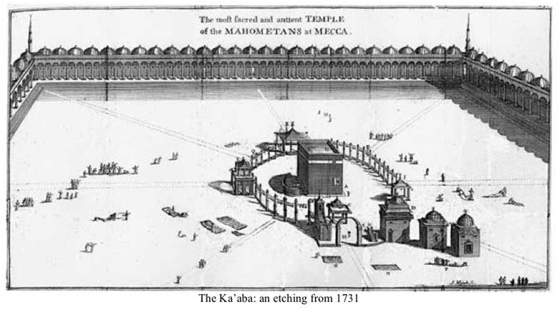
-The Kaabah (spelled a
variety of ways) is the cube-shaped structure in Mecca which housed the pagan
idols from pre-Islamic times. Muhammad smashed these and insisted on one God.
According to the Qur'an, the Kaaba was built by Ibrahim (Abraham) and his son
Ismail (Ishmael). Other stories
even suggest that Adam built it and it was restored by Abraham.
Six basic beliefs shared
by all Muslims:
-Belief in one God, the
same God worshiped by other monotheistic traditions.
-Belief in the Angels.
-Belief in the divinely
inspired books: The Scrolls of Abraham, the Tawrat sent to Moses; the Zabur
sent to David, the Injil sent to Jesus, and the Qur'an sent to Muhammad.
-Belief in the prophets
and messengers (including Abraham, Moses, and Jesus).
-Belief in the Day of
Judgment - Heaven and Hell.
-Belief in Fate.
The Five Pillars of
Islam:
- (Kalima) There is none worthy of worship
except God and Muhammad is his servant and messenger. (La ilaha illa Allah: Muhammad rasul Allah.)
- (Salat) Five daily prayers directed
towards Mecca. (Fridays are elevated in importance.)
- (Sawm) Daylight fast during the month of
Ramadan - no food, drink, sex, or smoking.
- (Zakat) Charity - Between 2% and 10% of income is to be shared with poor.
- (Hajj) The pilgrimage to Mecca once in a
persons lifetime. Circle the Kaaba 7 times, CCl, view/kiss sacred black stone,
visit the sacred well (Zamzam), throw 49 stones at the pillar representing Iblis (The
Devil). These rituals were established even before Muhammad but were
incorporated and reinterpreted by him.
A few basic definitions
and some trivia:
Sunni Muslims: (Sunni, meaning
“Principle”) currently the largest subdivision of Islam. They follow the
example of Muhammad and are uninterested in lineages. [Saddam Hussein and his
Baathist party are Sunni as is Saudi Arabia in general.]
Shi’ite Muslims are the
2nd largest subdivision. They believe that Islamic leaders are divinely
appointed and are direct descendants of Ali, Muhammad’s cousin and son-in-law.
(Sunnis are opposed to this philosophy of dynastic rule.) They also believe
that taxes must be paid on profit.
Most of Iran and the majority of people in Iraq are Shi’ite. [Note that
Saddam Hussein was Sunni.]
Osama Bin Laden:
technically he is Sunni, like most from Saudi Arabia, where he is from. He has not tended to inflame
Sunni-Shi’ia tensions. However his
latent support of a virulent anti-Shi'ite, Abu Musab al-Zarqawi (killed 2006),
connects him directly with anti-Shi'a activities. It is unclear if Bin Laden will pursue this anti-Shi’ia
direction in the future or if his support of al-Zarqawi was just an aberration
born of political opportunism.
It should be noted that
for the vast majority of Islamic history, these two sects have, for the most
part, gotten along. Shi'a shrines
in Sunni cities are protected and vice versa. In modern Iraq members of the two sects commonly intermarry
and frequently live side by side without any problem. However, there is also a long history of inter-sectarian
violence and the two sects have a rather sordid early history.
Jihad – Generally
thought to be an internal spiritual struggle towards goodness, the correct
path, and understanding. It has something of a philosophical, spiritual, and
metaphysical flavor. Some more radical elements interpret jihad to be an external struggle against
others who have not accepted the basic tenets of Islam. This more violent,
extraverted definition is the prevalent definition used in the West. Perhaps an analogy would help. Crusade is to Muslim as jihad
is to Christian. [Now I'm going to
take this analogy thing too far....however... jihad is not to Muslim as jihad is to Christian ... and
... crusade is not
necessarily to Christian as crusade is to Muslim. Sorry for the confusion, but I couldn't
resist.] From an Islamic
perspective the word "crusade" is how we perceive the word "jihad."
Circumcision is
practiced by Muslims. In a few places females are also “circumcised”
(clitoridectomy) but it is more a social custom than a religious practice. Some
Christian groups also perform female circumcisions.
Salaam = peace
Quick info-blurb on...
Salah ad-Din or Saladin.
Saladin: (Sunni) Kurdish
Muslim who retook Jerusalem in 1187 AD. Unlike the Crusaders who took Jerusalem
in 1099, he didn’t kill everyone in sight when he won. He was relatively respectful (in some
sense following the example of Muhammad when he took Mecca in the 7th century).
Christians and Jews were not expelled or executed en masse. This was a
significant and much commented upon in the west. All the same, news of his capture of Jerusalem was not well
received in the west and prompted the 3rd Crusade.
The Ottomans and the
Ottoman Empire
(Sometimes called the
Turkish Empire)
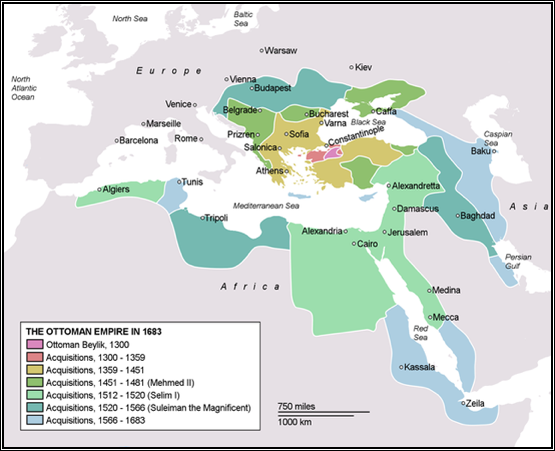
This long-lived Sunni
Islamic empire existed in one form or another from 1299-1922/3.
It was founded by Ossman
I [also spelled Osman I] (r.1281/99?-1326) His followers were referred to
as Ottomans (not Ottomen, which sounds more correct, but isn't). 14th-century Ottomans were generally
tolerant of Christians and Jews, who were not as much of a threat as other
Islamic powers to their East and South.
One of the greatest
Ottoman rulers was Mehmet II (r. 1451-81). On May 29, 1453 the Ottomans
conquered Constantinople after a 53-day siege. The walls were breeched by huge cannon balls (up to 25"
in diameter - by comparison a basketball is only 9" in diameter) shot by
correspondingly huge cannons.
[Here is a link to
a short description of the cannon type.]
The fall of Constantinople sent shock waves through Europe. It looked
like Christendom was on the ropes.
The Ottomans were coming!
In a way, the Ottomans were now the new Roman Empire.
Trivia: Constantinople
wasn't officially renamed Istanbul until the 1930s, seven years after the Ottoman
Empire fell. The name was used
colloquially from about the 10th c.
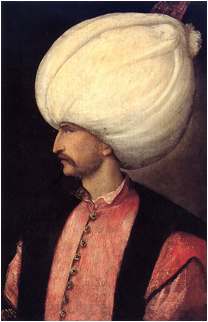
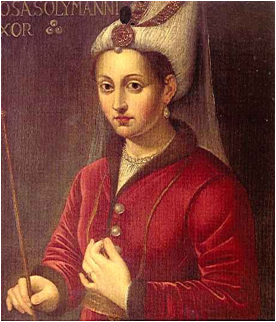
Left:
Suleiman the Magnificent - attributed to Titian - 16th c.
Right:
Hürrem Sultan
a.k.a. Roxelana (1510-1558) - anonymous - 16th c.
Suleiman (Süleyman or
Solomon) the Magnificent (r. 1520-1566) ruled the longest of any Ottoman ruler and
was perhaps the most famous. He led the Ottoman expansion which stretched from
Hungary, to most of North Africa, into the Middle East. He even unsuccessfully
attacked Vienna, Austria. Suleiman's best friend from childhood was a Greek
convert to Islam named Ibrahim Pasha.
Suleiman's favorite female in his harem was Roxelana (later called Hürrem Sultan)
a slave from an eastern European Orthodox family. Suleiman's initial interest in Roxelana made the former
favorite, Mahidevran,
jealous. Mahidevran was the mother
to the heir to the throne, Mustafa. In a jealous
rage Mahidevran beat up Roxelana.
The Sultan was not pleased and sent Mahidevran and Mustafa to live in
another city. Roxelana's meteoric
rise from slave/concubine to favorite member of his harem all the way to being
the Sultan's legal wife was highly unusual and raised many eyebrows in his
court.
The
following is a popular version of the soap opera that was the court of Suleiman the Magnificent.
[I've
put this together from several sources.]
The story goes something
like this.... Roxelana wanted more and more power. [This story tends to be rather misogynistic. My apologies.] Her way to power was to have one of her
sons succeed Suleiman. The problem
was Mustafa, the son of Mahidevran.
He was the oldest son of Suleiman and was the logical heir to the
throne. Making matters worse, in
this time and place, it was common practice for competitors to an heir to be
murdered. This made succession
more clear cut and not confused by competing princes. The prince Mustafa was
the heir, so Roxelana's sons with Suleiman were in danger.
The three or four
strikes against Ibrahim – Ibrahim Pasha, best childhood friend of
Suleiman, high ranking official, and commander of military forces, was a strong
supporter of Mustafa. This didn't sit well with Roxelana. Even worse, while in command of an army
fighting against the Persian Safavids, Ibrahim gave himself the title,
"Sultan." That didn't
sit well with Suleiman. To top it
off, Ibrahim was rumored to be hatching a conspiracy against Suleiman. The final straw might have been
Roxelana, behind the scenes, convincing Suleiman to get rid of Ibrahim. Not only did Ibrahim support Mustafa,
not one of her sons, but she also had a relative who wanted his job.
With all of the evidence
against Ibrahim, Suleiman knew he had to kill him. Even Ibrahim knew that
Suleiman was going to kill him.
Each knowing what they did, but pretending that they didn't, Suleiman
and Ibrahim had dinner together seven times leading up to his
execution/assassination. Suleiman,
it is speculated, was hoping that Ibrahim would run off and escape, but Ibrahim
stayed true to his old friend. On
the Ides of March, 1536, Ibrahim's body was found strangled to death in the
palace. Suleiman is said to have
dramatically changed from that day forewords. He was profoundly affected by the execution of his best
friend. Much of the poetry
Suleiman wrote after that date stresses friendship and loyalty. He must have been terribly conflicted.
With Ibrahim out of the
way, Roxelana was able to install her son-in-law, Rüstem Pasha, in the newly
vacated position. Several years pass.
Then Rüstem circulated rumors that the armies were hoping that Mustafa
might take over the Empire. He
also circulated the rumor that Mustafa was ready and willing to take over. The final straw was when he convinced
Suleiman that Mustafa was actually going to kill him when they next met. When Mustafa entered Suleiman's tent on
October 6, 1553, he was attacked and killed by the Sultan's eunuchs. With Mustafa dead you might think that
one of Roxelana's sons could become the heir to the throne. It wasn't so simple. Roxelana had three sons.
Long story short. One son supposedly died of grief upon
hearing about his half-brother's death.
The other two sons, each with their own army, fought it out. The loser ended up in an alliance with
the Persians. He was ultimately assassinated
on Suleiman's orders. The remaining
son, Selim, eventually became Sultan.
He was known as "Selim the Drunkard" and supposedly died when
he slipped and fell on some wet tile work while drunk.
Roxelana comes off as
nasty and power hungry in this version of events. This may be the result of historians trying to mine a good
story from the dates and events.
This is called abductive reasoning. It isn't always right.
The Safavid
Empire (Shi’ite), from the area of modern-day Iran and Iraq, were
probably Suleiman's greatest enemy.
This dynasty lasted from about 1501-1722.

Generally speaking the
Ottomans had good relations with Jews. Jews were often employed in court.
During this period of Suleiman, gunpowder begins to be used extensively. Very sophisticated legal systems were developed. Under Suleiman the Dome of the Rock in
Jerusalem was refurbished.
Hospitals, schools, libraries and a variety of social institutions were
encouraged. Art, poetry, and
philosophy flourished under Suleiman.
Trivia:
All courtiers had to be
quiet in the presence of Suleiman.
The Ottoman had a
special class elite guards called Janissaries. This force was made up of
Christians who had been specially trained form childhood. As they were
Christians, they were considered to be more trustworthy since they had no
family connections that might conflict with their duties. They were so well
educated and became such important people in Ottoman society that many Muslim
families tried to pass their own children off as Christian in order to get the
special treatment and opportunities.
Another special class in
Ottoman courts were eunuchs. These
were castrated men who ran the sultan's harem and worked in the palace
schools.
The
Moors in Spain
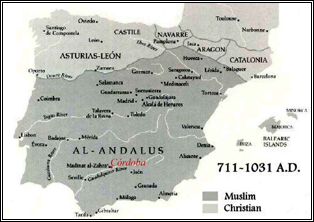
Islamic
Spain
The Moors, Muslim
Berbers from North Africa, invaded the Iberian Peninsula in 711 AD and easily
defeated the Visigothic (Christian) rulers there. Although they didn't hold the northern areas for long, they
flourished in the south, Al Andalus (Andalusia), for several centuries. Cordoba became the greatest city in
western Europe during the Middle Ages and all three monotheistic religions
lived side by side without very much conflict. Some of the greatest western philosophers, doctors, poets,
astronomers, mathematicians, and natural philosophers (proto-scientists) lived
and wrote there. This blossoming of intellectual activity directly led to a
revival of intellectual activity in places like Paris and Italy in the 13th and
14th centuries, leading full-throttle into the Renaissance. The importance of Moorish cities in
Spain to the intellectual development in the rest of Europe cannot be
emphasized enough. They exported
major works in Latin, Arabic, and Hebrew all over the world.
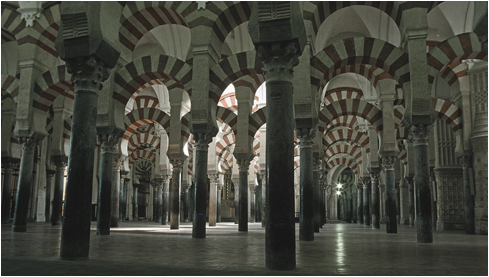
Inside
the Aljama Mosque, now called the Mezquita, in Cordoba.
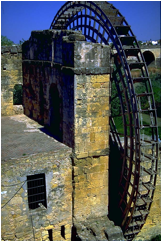
A
waterwheel built by the Moors near Cordoba.
Piri Reis Map of 1513: General/Piri_Reis_Map_of_1513.htm
- VIII.