Early Islam
PART I
The Birth of Islam
Muhammad (spelled any number of
ways) was born 570 A.D. in Mecca, on the Arabian peninsula. [Early_Islam-GoogleMap-170KB.jpg]

Muhammad was raised in a clan
culture which was the dominant “political” structure of the Arabian peninsula
in that period. (Much of the
peninsula is still ruled by royal ‘clans’ such as the Sauds, hence the current
name, Saudi Arabia, Arabia of the Sauds.)
A popular saying in this culture goes, "I against my brothers, I
and my brothers against my cousins, I and my brothers and my cousins against
the world." In this form of
society there was no centralized governing body which ruled all people of a
region. Rulers ruled over family
units.
Note: In a similar way in which
Christianity took on the institutional structure of the Roman Empire, Islam is
some way can be thought of as having taken on this clannish structure. This may explain why there is no
central religious authority in Islam that is analogous to the pope.
Wells are a big deal in Bedouin
nomadic culture, as much of the Arabian peninsula is arid desert. As a result wells and water in general
is a general theme throughout Islamic literature.
Mecca was a thriving commercial
center and major crossroads of trading routes. It also was the home of the Ka’aba (the ‘Cube’). Before Muhammad changed things in 630
AD the Ka’aba was a shrine to local deities of the polytheistic traditions that
were dominant in Arabia at that time.
In particular the Ka’aba was dedicated to Hubal and there were 360 idols
set up honoring him in and around the Ka’aba. In general the polytheistic deities of the Arabian peninsula
represented such natural forces as fire, water, and wind… etc. The Ka’aba also housed the Sacred Black
Stone which is claimed to have fallen from the sky. Some traditions suggest the Sacred Black Stone absorbs sins
from those who make contact with it and that over the years because it has
absorbed so much badness it has darkened to its present color.
The Ka'aba and the Sacred Black Stone today:


The
Portal (Hajar Aswad) for viewing and touching the Sacred Black Stone
can
be seen in the interior plan above and is evident in the 18th-century etching
below.
Back to the 7th-century story...
Because the Ka’aba was such a
sacred place for so many people with so many differing beliefs, the region
around it was demilitarized (no weapons or fighting allowed). This oasis of peace had the side effect
of encouraging trade since the fear of attack and piracy was lessened in a
demilitarized area. By the 6th
century Mecca was a thriving center of business and religions and people
passing through would have been from all over the world. A new economy of trade grew up around
Mecca and clans that had previously raised camels or sheep or goats and lived
as nomads started to take up the business of trade and shipping. These Arabian
traders were very aware of different cultures, particularly the Jewish and
Christian cultures which existed to some extent on the Arabian peninsula, but
were dominant to the northwest.
The Christian Byzantine Empire (the Eastern Roman Empire) was a major
power in and around Constantinople and their level of sophistication must have
been mind boggling to nomads accustomed to living in tents and caravans.

It was and is
claimed that Ibrahim (Abraham) and his son Ismail built the Ka’aba. Abraham is usually dated somewhere
around 1800 BC, give or take a few hundred years. Other traditions claim that it was built by Adam and then
restored by Ibrahim and Ismail.
The Shi’a claim that Ali ibn Abi Talib, the cousin and son-in-law
Muhammad and the basis of the Shi’a sect, was born in or at the Ka’aba. At the time of Muhammad the Kabah
(spelled multiple ways) was dedicated to Hubal, a Nabatean deity, and there
were 360 idols arranged in and around the Kabah.
Muhammad was an orphan and was
essentially clannless as a young man.
He survived as a trader. In
595 A.D. at the age of 25 he married an older widow named Khadijah who had many
good trade contacts and was a savvy businesswoman from a powerful clan, the Quraysh. One of the first signs of Muhammad’s skills as leader and a
man of peace occurred when a violent argument broke out between rival clans
over the movement and placement of the Sacred Black Stone in the Ka’aba which
was undergoing renovations.
Muhammad brokered a deal between the angry partisans by having them all
share in the task of moving the stone placing it in a cloak, which allowed for
many people to share in labor.
This solution calmed the hot tempers and Muhammad gained a reputation
for fairness and wisdom, which spread far and wide.
In ca. 610 A.D. in a cave above Mecca where Muhammad was
praying and fasting during the month of Ramadan, the Angel Gabriel came to
him. God/Allah was revealed to
Muhammad as the one true God and Muhammad was to be his messenger or prophet. Islam is most definitely a monotheistic
religion which is not only similar to Judaism and Christianity but worships the
same God. (This is, of course, debatable depending on how particular you are
about definitions and sources.)
Muhammad is the messenger of this one God to the people of the Arabian
peninsula, much like Moses was the messenger of the one God to the people of
Judea/Egypt or Jesus was the messenger of the one God to the people of Roman
ruled Judea/Palestine/Israel. It
should be noted, though, that unlike Jesus, Muhammad was not divine, he was
completely human and not in any way to be worshiped. In fact the first pillar
of Islam reads, “There is none worthy of worship except God and Muhammad is His
servant and messenger.” Muhammad
is not His son or heir.
But, like Christianity, Islam is based on a Judaic foundation. Also much like early Christianity,
Platonic and Aristotelian influences are evident in the early Islamic
philosophy.
The Quran
(also spelled Qur’an or Koran), is the literal transcription of the revelations
Muhammad received starting in 610 in the cave above Mecca and which continued
throughout the rest of his life.
According to one tradition these revelations were not written down by
Muhammad for he could not read or write, but he memorized the revelations and
recited them to his followers who either wrote them down or memorized
them. Another tradition claims
that Muhammad was illiterate, but that he miraculously was able to write down
the revelations. Like everything
associated with the early years in any religion, scholars and theologians
debate all of the details.
Arguments (sometimes violent in nature) arose in the initial years after
Muhammad’s death concerning which versions of the Quran were the true words of
the prophet and thus the true intentions of God. From a religious point of view the Quran is a miracle in and
of itself.
In 612/3 A.D. Muhammad starts to preach. Two of the earliest
converts to Muhammad’s God were his cousin Ali ibn Abi Talib (born ca. 599 and
thus quite young at this point and later the founder of the Shi’a sect) and his
friend and later one of his fathers-in-law Abu Bakr (born ca. 573 and the first
of the 4 Rightly Guided Caliphs revered in particular by the Sunni sect). [You may notice that the seeds of sectarian
(or denominational) conflict are sown pretty early.]
By ca. 616 some 70 families had “converted” to Islam. The teachings communicated by Muhammad
stressed community (ummah), charity,
and benevolence. In fact, the word, Islam,
which literally means “surrender” has its roots in “salam,” which means “peace.” But the one God of Muhammad also
disparaged greed and lust and the materialist culture which was thriving
amongst the wealthy and powerful clans of Mecca. One of these powerful clans was Muhammad’s own clan, the Quraysh. By 616 much of the powerful elite of Mecca opposed Muhammad
for his ideas threatened their power and immense wealth. Muhammad was essentially preaching the
redistribution of wealth. (Rich
people never seem to like this idea much.) But the poor and the disenfranchised (women and slaves in
particular) found these ideas to be very appealing. (The parallels to the teachings of Jesus are quite
remarkable.) The powerful of Mecca
imposed a boycott against Muhammad’s group. This led to hunger and strife amongst his fellow Muslims.
Many died as a result of this boycott or as a result of violence directed
against them.
In 619 A.D. (the Year of Sorrow) Muhammad’s wife Khadijah
died, perhaps as a result of this boycott (although she was significantly older
than Muhammad). Also his uncle and primary protector Abu Talib died. Because of these deaths Muhammad was no
longer under the protection of any clan.
His ties to powerful people evaporated. His position in Mecca is now extremely tenuous.
In 620 Muhammad has a vision/journey. He rides on a “Buraq” and visits Mecca,
Jerusalem, and Heaven. A buraq is
a flying, horse-like creature. It
sometimes is shown with a female head and sometimes with an eagle’s head.

Muhammad
riding the Buraq - from a 16th c. miniature.
At
certain points in history it has been forbidden to show
Muhammad’s
face in order to dissuade any form of idolatry, hence the shrowd.

A
Buraq on the back of a Pakistani bus.
The place in Jerusalem where he is supposed to have lifted
off for heaven is where the Dome on the Rock (built late 7th c.) now stands.

Dome
of the Rock, Temple Mount, Jerusalem
In
the foreground is the Al-Buraq Wall also known as the Western (Wailing) Wall.
It
is from here that Muhammad flew off to visit Heaven.

Muhammad
(upper right) visiting Paradise while riding Buraq, accompanied by the Angel
Gabriel (upper left). Below, riding camels, are some of the fabled houris of Paradise -- the
"virgins" promised to heroes and martyrs.
Persian,
15th century, from a manuscript entitled Miraj
Nama, which is in the Bibliotheque Nationale, Paris.
You'll
notice in this image, Muhammad's face is shown.
In 622 Muhammad and his followers are driven out of
Mecca. He goes to Medina, a small
city about 200 miles north of Mecca. [See map: Early_Islam-GoogleMap-170KB.jpg]
Because of his reputation as a man of peace he is asked to broker a deal
between warring clans. He is given refuge in Medina. Islam is officially born during this journey referred to as
the hijrah. This marks the year 1 of
the Islamic calendar. The Islamic year as of April 2007 is the year 1428 AH (or
simply 1428 H). AH is Latin
for anno Hegirae (in the year of the Hijra). This is
exactly like AD, anno Domini (in the
year of the Lord). Notice that
2007-622=1385 and not 1428. The
reason for this is that the Islamic year is not based on the sun, but is based
on the moon and is about 354 days long, a difference of about 3%. If you want to do the math here it is:
1385years x 365 days = 505,525 days.
Divide this by 354 and you get 1428.
Life in Medina
The first mosque is in Muhammad’s home in Medina. A
community based on this shared religious belief formed around Muhammad. In Medina Muhammad took on the role of
a chief (sayyid) and had a large
harem. This was normal in Arabian
society. Most of the marriages
were politically motivated. His
favored wife was Aisha, the daughter of Abu Bakr, his good friend, and as of
this marriage, also his father-in-law. None of Muhammad’s wives bore him any
children, except for Khadija, his first wife from Mecca, who at this point is
dead. Depending on the source,
only 4 daughters by Khadija survived into adulthood.
Link
to Muhammad’s Family Tree [204KB]
![Link to Muhammad’s Family Tree [204KB]](http://www.mifami.org/eLibrary/Newsome-et_al-Early_Islam-pics/Muhammad_Family_Tree-annotated-204KB.jpg)
Muhammad was known for being
quite lenient to his wives. He was
not harsh and strict and severe like many husbands of his cultural
background. He treated them almost
as equals and listened to their advise in many occasions. Under Islam women had some new rights
such as the possibility for inheritance and divorce. The Islamic tradition of veiling women started several
generations after Muhammad’s death.
Whether or not it is required of a Muslim woman is still debated.
While in Medina,
Muhammad learned more about Judaism and synthesized various elements from it
into Islam. In particular, the
story of Ismail, son to Abraham by Hagar (the concubine) was incorporated. Ismail and Hagar were cast in to the
wilderness by Abraham but local tradition had it that God saved them and
promised Ismail that he would be the father of a great Arab nation. At this time in Islamic practice prayer
was directed towards the city of Jerusalem, the great city of Judaism and
Christianity.
Local Arab tradition
also claimed that Abraham, Ismail, and Hagar rebuilt the Ka’aba in Mecca, which
had originally been built by Adam but had fallen into disrepair. This connection to Judaism and to the
Ka’aba gave Arabs both a very old monotheistic lineage and a connection to the
local polytheistic cultures.
But many of the
local Jewish and Christian groups were loathe to admit that their god was the
same as this seemingly new Islamic god.
This rejection by the Judeo-Christian communtiy ultimately led to a
reorientation for the daily prayers, salat,
from Jerusalem to the Ka’aba in Mecca.
The followers of Muhammad, mostly traders, were
at a loss for employment in the primarily agricultural town of Medina. There was nothing to trade and the farm
land was already spoken for. As a
result, Muhammad’s people took to raiding trading caravans from Mecca taking
care not to kill anyone for fear of blood reprisals. Mecca responded by assembling an army to deal with these
acts of highway robbery. There
were numerous skirmishes. A
pivotal battle which ensued, called the battle of Badr, took place on March 17,
624 CE (17 Ramadan 2 AH in the Islamic calendar). By the numbers was very lopsided
in favor of the forces put together by Mecca. The story is usually told that were about 1000 men from
Mecca versus 313 men and boys from Medina, under the command of Muhammad. Muhammad’s unified force won and locals
watching this all take place were very impressed. They apparently got a kick out of seeing the bad-ass Meccan
forces get clobbered by the much smaller but better organized forces of
Muhammad. This ended up attracting more and more people to the ummah that Muhammad was assembling in
Medina. Several more decisive
victories by Muhammad’s forces followed.
While in Medina Muhammad had had a revelation in which he
was instructed to rescue the shrine of Abraham (the Ka’aba). Abraham was the first true believer in
the one and only God, and the shrine had been overwhelmed by pagans for
centuries. So Muhammad announced
in 628 that he was going to make the hajj
to Mecca. Obviously this was a
dangerous proposal since Muhammad and Mecca were, for all practical purposes,
at war. He negotiated a peace
treaty with the dominant clan of Mecca, the Quraysh, his own former clan. But many in the clan did not want peace
and they violated its terms by attacking one of Muhammad’s allies. So in 630 AD Muhammad assembled an army
of 10,000 men and marched off to Mecca.
His army was so large that the Quraysh did not put up any fight at
all. Muhammad took control of
Mecca. His forces surrounded the Ka’aba, circumnavigated it 7 times, and then
smashed all of the polytheistic idols associated with it much like Moses
shattering the tablets in reaction to the “golden calf.” They did not destroy the sacred black
stone. With the pagan idols destroyed he rededicated the Ka’aba to the one God
of Abraham. He also reworked the
rites of the hajj to make it into a
monotheistic ritual.
Unlike victorious armies in the Arab tradition of the time,
the Muhammad's forces did not sack, loot, destroy, or pillage the city of
Mecca. This was considered an
extremely unusual act of mercy. He
allowed the inhabitants to live as usual and did not insist that anyone convert
to Islam. This act so impressed
the Meccans that many converted anyway.
This benevolent gesture on Muhammad’s part is one of the most famous of
his acts and several subsequent Islamic military leaders have emulated it
explicitly. The larger objective
for Muhammad was the ummah, the
community. He wanted peace.
In the 11th year
of the Islamic Calendar (632 AD)
Muhammad died in Medina. At this point most of the tribes of the Arabian
Peninsula had joined the ummah
(community). The infighting was
under control and the entire region was unified and relatively peaceful. Muhammad had succeeded.
PART II
The ummah built by
Muhammad grew larger and larger especially after his decisive military
victories over Mecca. [See map
below.] After Muhammad’s death the
affairs of the ummah did not get
simpler, they became much more complex. While Muhammad was alive the ummah was relatively small and he
received regular revelations from God concerning how to manage earthly
affairs. After his death the
revelations stopped and various clans reasserted their autonomy. The one large ummah led by Muhammad was fragmenting in his absence. The structure of Islam after Muhammad’s
death was not certain. Should it
be a gigantic community with a central authority similar to how Muhammad
arranged things. Or should it be a coalition of smaller communities each with
their own Imam (leader) with local
authority and no centralized power?
It wasn’t entirely clear.
Muhammad, though not divine, was most certainly special. He was the perfect exemplar of God’s
intentions on earth. Could it be
expected that anyone else without such prophetic qualifications could rule all
of Islam as Muhammad had? How
would such a leader be identified?
Would they be selected on their merit as a Quranic scholar or their
abilities as a military or administrative leader or on blood lines like a
family structure? There were no
easy and undisputed answers to these questions.
Note:
Succession is almost always a topic for strife. Who gets to rule next is always a tricky question,
especially after a really powerful and well loved leader dies. When there is not an obvious successor
or the obvious successor is not well liked, there can be huge problems. Systems of government which account for
this tend to be more resilient.
This is one reason why the U.S. is currently a very strong nation or at
the very least this is a sign of how stable the U.S. is. We accept our process
without much argument, even if a person wins the Electoral College count but
not the popular vote. There was
not a civil war in 2000 or a major rebellion. We all grumbled and felt a bit uncomfortable and perhaps
wrote some letters to the editors of various newspapers. But mostly we just all went shopping
and tried to figure out how to program our cell phones. Throughout recorded
history various governments and economies have fallen with surprising speed. Rulers rarely if ever see it
coming. […must have something to
do with a human capacity for wishful thinking.]
Immediately after Muhammad’s death, the leaders within the
Islamic community argued for a large-scale unified ummah and this style of governance dominated for the first few
decades of Islam after Muhammad’s death.
A significant faction within the community insisted that Muhammad had
wanted his cousin by marriage (and son-in-law) and early convert to Islam, Ali ibn Abi Talib (referred to above),
to be his successor, but Ali was in his early 30s at this point and the
venerable Abu Bakr was elected to be
the first leader of Islam in 632.
[This faction that favored Ali will be important very soon.]
Link
to Muhammad’s Family Tree [204KB]
The 4 “Rightly Guided” Caliphs, The Rashidun-
these were the first four leaders immediately after Muhammad’s death.
The First Caliph:
Abu Bakr (ca.
573-634) - Reigned from 632-634.
He was the father of Aisha, supposedly Muhammad’s favorite wife, after
the death of Khadija. Abu Bakr,
about three years younger than Muhammad, was one of the first converts to Islam
in the early days in Mecca (see above). He had been close to Muhammad from the
very beginning. The first few
years after Muhammad’s death were very chaotic. Many clans who only superficially accepted Islam under
Muhammad’s very popular rule broke away from the ummah after his death and many leaders claimed to have prophetic
“revelations.” Abu Bakr managed to
unify these rebellious factions and direct their energies on raiding foreign
powers rather than attacking each other.
This focused aggressions outwards and not inwards. This also made the rebellious leaders
richer. Under Abu Bakr the vast
majority of the Arabian Peninsula was brought under Islamic rule. [See map below.] Most believe that Abu Bakr died of
natural causes. He prepared for
his death by promoting a successor, Umar
ibn al-Khattab, who was generally accepted by the larger Muslim community. There was, however, a faction that
wanted Ali ibn Abi Talib to lead the
ummah.
The Second Caliph:
Umar ibn al-Khattab
(ca. 580-644) - Reigned from 634-644.
10 years younger than Muhammad.
Umar [also known as Omar] was one of the more dramatic converts to Islam
because he was very much opposed to Muhammad in the early years before the hijrah. Some accounts suggest that Umar actually wanted to
assassinate Muhammad, but that he was won over by the beauty and truth of the
Quran. He and Abu Bakr were Muhammad’s closest advisors after the hijrah. In 625 one of Umar’s daughters married Muhammad, and like
Abu Bakr, he became a father-in-law to Muhammad. Upon the death of Abu Bakr,
Umar was quickly approved/elected as the second Caliph, again over the
objections of the party loyal to Ali
ibn Abi Talib, Muhammad’s cousin.
Supporters of Ali claim that Umar was responsible for the death of
Fatimah, Ali’s pregnant wife and Muhammad’s daughter. (It is unclear when this story gained in popularity.) Under
the leadership of Umar, the Persian Empire was conquered. Islamic influence spread to encompass
much of Egypt, Mesopotamia, and the Levant (Israel/Palestine, Jordan, Lebanon,
Syria). He took Jerusalem in 638 AD.
[See map below.] His role
as primarily a military leader made his rule over the larger ummah more acceptable to the various
clans, who were not accustomed to being ruled by a central authority. Foreign campaigns with a single
strategic leader made sense to them (like a Roman dictator), but a leader who
ruled day-to-day administrative affairs did not. His style of rule was not entirely
religious in nature. Under Umar
this was basically a secular expansion and not a religious holy war. The
expansion was for booty and the well-being of the ummah. The Muslim
forces preyed on adversaries who were weak from either fighting each other or
from fighting amongst themselves or who felt alienated from their central
powers like the far flung Byzantine-ruled lands in North Africa. After the initial conquests, these
regions enjoyed rather peaceful times and religious toleration was the general
rule. Once conquered, most people
became protected subjects (dhimmis)
of the Islamic Empire. As dhimmis they could practice their
religions and organize their society however they wanted so long as they
acknowledged Islamic rule and, of course, paid their taxes. Many non-orthodox Christians actually
preferred Islamic rule to Orthodox Byzantine Christian rule since the Islamic
rulers did not persecute them.
They were left alone to worship as they pleased. Also, Islamic conquerors did not
confiscate land from the people they conquered. They built their own Islamic garrisons/town separate from
the local populations. Basrah in Iraq was originally built as one of these
towns. Umar was killed by a
Persian prisoner-of-war in a mosque in Medina in 644. Umar had prepared a successor, Uthman ibn Affan, who quickly ascended to power, but much violence
followed Umar’s death. The party who
favored Ali was now seething mad.

This
map is from Armstrong’s Islam, p.
26. I colorized it for clarity.
The Third Caliph:
Uthman ibn Affan
(ca. 580-656) – Reigned from 644-656. He was about the same age as Umar. Generally considered to be weaker than the first two caliphs. He actually married two of Muhammad’s
daughters according to Sunni tradition.
Under Uthman the Empire continued to expand particularly adding Cyprus
and much territory in Anatolia (Turkey) and moving west in North Africa into
what is now Libya. [See map.] The policy of not seizing land in
conquered territories was becoming very unpopular amongst the rich and powerful
Meccan families as well as with the military. [For comparison, when Rome conquered territory, they often
confiscated the land and gave it out as pay to the soldiers. This probably made the soldiers happy
but angered the conquered people.
Here the situation may have been reversed. The conquered people were pleased by this policy and the
soldiers annoyed.] Why expand and
rule if you couldn’t confiscate in land?
Also Uthman was terribly nepotistic, giving valuable and powerful
positions to family members and loyal partisans. Petty jealousies grew amongst the most powerful
families. Uthman also angered some
of the religious elite by essentially banning all but one version of the Quran
in the provinces. Many of these
disgruntled Islamic scholars, soldiers, and wealthy elite looked to Ali ibn Abi Talib for assistance and
leadership. A loyal party of
followers had always followed Ali, but now with Uthman's unpopularity, Ali
appeared even more attractive.
Finally discontent reached a boiling point. There was a mutiny, and in 656 Uthman was assassinated, and
the mutineer-assassins promoted Ali as the new caliph.
The Fourth
Sunni Caliph and the First Shi’a Imam: Ali ibn Abi Talib (ca. 599-661) – Reigned
from 656-661. Shi'a, or Shi'at Ali, “the partisans of Ali.” It is at this point that the Shi’a and
what would eventually become the Sunni factions fully diverge. Ali was the son of Muhammad’s uncle Abu
Talib (Muhammad’s father’s brother), making him Muhammad's cousin. Ali is
further related to Muhammad because he married Fatimah, Muhammad’s only
undisputed daughter. This makes Ali a blood relation and a relation through
marriage. He is the cousin and
the son-in-law of Muhammad. (Only
Uthman could claim a similar level of relation to Muhammad, but Uthman did not
have any blood line relationship.)
Because uncle Abu Talib served as Muhammad’s father for all practical
purposes, Ali was basically Muhammad’s kid brother. It should be stressed that Ali, though the first Imam
for the Shi’a, is the Fourth Caliph for the Sunni and is held in the highest of
esteem. The two traditions have
very different stories associated with his life and his relationship to the
first three caliphs. The Shi’a
stress the anger, violence, and greed of Abu Bakr, Umar, and Uthman, whereas
the Sunni emphasize the stable tradition of leadership and general harmony. These histories are beyond complicated.
Ali was probably not thrilled that the assassins of Uthman
were his partisans. Ali was quite
devout and in all likelihood would not have approved of such violence within
the ummah. Making matters worse, Ali did not punish Uthman’s murderers
which further angered the partisans of Umar and Uthman. Uthman’s assassination prompted a
5-year civil war. The Muslim world
was never really united under Ali and in 661 in the city of Kufah (Iraq) Ali
was assassinated by way of a poisoned sword by an extremist devout group known
as the Kharajites. Ali’s son, Hasan, was supported by Ali’s partisans
to be the new caliph, but he ended up making some political agreements and
retired to Medina unmolested until his death in 669. [The Shi’a seem to list Hasan as the 2nd Imam and
Sunni as the 5th Caliph, but it is not perfectly clear…] The man to emerge as the next leader
was a political appointment put in place by Uthman named Muawiyyah. He became
caliph and based himself in Damascus (modern Syria).
Muawiyyah ruled as caliph from 661-680. But his rule was not fully accepted and
the reigns of The Four “Rightly Guided” Caliphs, The Rashidun, ended with Ali’s death. The Sunni and the Shi'a were divorced due to irreconcilable
differences.
Two sons of Ali:
Hasan ibn Ali:
(624-669). Son
of Ali and Fatimah. Grandson to
Muhammad and Khadija. Significant
figure for both Sunni and Shi’a.
He is considered the Second Imam by the Shi’a. Some Sunni’s regard him as the Fifth Caliph if only for a
brief period of time in 661.
Hussein ibn Ali:
(626-680).
Younger brother of Hasan. Son of Ali and Fatimah. Grandson to Muhammad and Khadija. He is considered the Third Imam by the Shi’a. Killed in the Battle of Karbala (Iraq)
in 680. His head was carried
around Damascus by Muawiyyah’s (Sunni) forces as a sign of their victory over
Ali’s (Shi'a) lineage. The
anniversary of his martyrdom is celebrated by Shi'a Muslims in a public ritual
of self-flagellation called Ashura.
[This often gets some news coverage... a bunch of shirtless men striking
themselves with chains.]
General information on Islam and some trivia
The Shi’a (Partisans of Ali) emphasize a dynastic leadership
based on the family of Muhammad.
They make up roughly 10-15% of all Muslims and are concentrated in Iran,
southern Iraq and southern Lebanon.
Pockets of Shi’a also live in Saudi Arabia and Syria, Afghanistan,
Pakistan and India. Coincidentally
(or perhaps not coincidence), they are the native population surrounding about
80% of the oil in the Persian Gulf region.
The Sunni (literally meaning “principle” or “tradition”) do
not believe that Islamic leaders must be from the dynasty based on Ali. They elect their leadership based on
merit and devout Islamic principles.
For the vast majority of Islamic history the Sunni and the
Shi’a have lived side by side in peace and even cooperation. But whenever violence flares up between
the two sides it gets a lot of attention.
Both the Shi’a and the Sunni believe in the concept of the
Mahdi who is the prophesied redeemer of Islam. The Mahdi will change the world
into a perfect and just Islamic community (ummah). This will precede the second coming of
Jesus. Mahdi will work alongside Jesus to fight evil and
advance justice. They will both
battle the anti-Christ (Dajjal) who
has the word kafir (كاف),
“infidel,” written on his head.
This will lead into Yaum al-Qiyamah (literally "Day of the
Resurrection" or “The Last Judgment”)
Nonbelievers or unrepentant sinners will burn and the world will be
destroyed and the dead will rise to attend the Last Judgment. The sun and the moon will merge or be
extinguished. This story is pretty
vague and interpreted in many different ways.
The Mahdi, according to some Shi'a traditions,
is or was the 12th Imam known as Muhammad ibn Hasan ibn Ali, or
simply as Muhammad
al Mahdi. He was born in 868. At the age of five (874 AD) at the
funeral of his father, the 11th Imam, he led the prayer and then
literally disappeared. This is
called the Occultation, the hiding or the disappearance. He will someday reappear to prepare the
world for the Day of Judgment.
The Occultation supposedly happened in Samarra,
Iraq near what is now the Mosque of the Golden Dome, Al-Askari Mosque. This mosque is the shrine for the 10th
and the 11th Imams and literally next door is the shrine for the 12th
Imam, the Mahdi. In February of
2006 Al-Askari Mosque was blown up by Sunni militants. This event is generally considered to
be the point when the Sunni and the Shi’a were polarized and the civil war
began in Iraq. What is
particularly sad is that this mosque is located in a Sunni city and has been
maintained and secured by Sunnis for hundreds of years, even though this mosque
is of particular significance to Shi’ites. Every year more than a million Shi’ites would visit the
shrine and participate in Shi’a festivities. All of this would occur in a Sunni city without any
friction. But the peaceful
coexistence between the two major sects is being severely strained by violent
and extreme factions who want to polarize the entire society and perhaps also
think that they are paving the way for the arrival of the Mahdi and the Last
Judgment.
Update 6/13/07: The two minarets connected to the Mosque of the Golden
Dome which can be clearly seen in the following photograph were blown up. Al-Qaida (Sunni) is believed to have
been responsible.
Update 8/12/07: Haythem Sabah al-Badri is killed. He has been identified by the Iraqi
“government” as the man responsible for blowing up the Golden Dome in 2006.
Born in Samarra, he was formerly a member of Saddam Hussein’s Special
Republican Guard and then became the leader of a Sunni insurgent group actively
and successfully enflaming a civil war in Iraq. He is said to have had affiliated his group with "Al
Qaeda in Mesopotamia." It had
been previously assumed that a foreigner had blown up the mosque. This idea jibed with the theory that
large scale violence in Iraq was caused by foreign “jihadists” and linked to
Osama bin Laden. The idea that a
local (someone from Samarra) did such a thing was inconceivable.

There have been numerous people over the
centuries claiming to be the Mahdi [much like the periodic cults that form
around somebody claiming to be the Messiah] and there is almost always an
active sect predicting the immanent arrival of the Mahdi though generally not
mainstream sects. The Iraqi Shi’ite cleric Moqtada al-Sadr currently leads what
is called the Mahdi Army. He is
preaching that the coming of the Mahdi is near and that American forces are a
threat to the Mahdi’s divine prupose.
Not all Shi’a agree with his predictions. The Mahdi Army have carried out innumerable attacks against
American and Iraqi security forces and are considered to be one of the most
powerful organized forces in Iraq.
One thing that should always be kept in mind
when studying Islam is that there is not one form of Islam, nor is there one
form of Sunni or one form of Shi’a.
There is no central authority.
The ummah from the early days
is no longer united. There are
imams and spiritual leaders all over the world who do not have to clear their
ideas or predictions or pronouncements with any authority. It is much more difficult to draw
generalizations about Islam than about Christianity which, even though it is
divided into many denominations, is often ruled by central authorities. The Catholics have the pope and most
protestant groups have governmental structures with coherent policies. There is no central institutional
authority in Islam, but there are shared concepts and beliefs. All maintain the Five Pillars.
The Five Pillars of Islam
1. There is none worthy of worship except God and Muhammad
is his servant and messenger.
2. Five daily prayers (salat
or salah) directed towards the Ka’aba
in Mecca. Some accounts state that
Muhammad originally prayed towards Jerusalem while living in Medina, and then
he was commanded by God to face Mecca. Which way to face is not as easy as it
might seem at first. For example, what way would you face if you were in
Alaska? If you refer to a flat map like a Mercator projection (a standard
looking world map) it seems that you should face East and a bit South.

On
a ‘flat-map’ Mecca is ESE for a person in Alaska.
But if you look at a
globe, Mecca appears to be to the North and a bit West, up over the North Pole.

Looking
at a Globe, Mecca is NNW if you are in Alaska.
According to tradition Muslims face Mecca orienting
themselves using a flat-map and not a globe even though Muslim astronomers were
well aware of the spherical shape of the earth. (There is a very small minority
who orient themselves according to a globe.)
3. Daylight fast during the month of Ramadan. No eating,
drinking, or sex during daylight, but exceptions are made for people with
special issues.
4. Charity for the poor.
5. The Pilgrimage to Mecca (hajj) once in a persons lifetime. Exceptions are allowed for people with good excuses. Saudi
Arabia limits how many people may perform hajj
each year making it is physically impossible for all Muslims to do it.

The
Ka’aba in recent times during hajj.
The Ka’aba is located inside the mosque called,
Masjid
Al Haram. The Ka’aba is not worshiped per
se, but is the shared focal point for prayer.
.... back to the historical story ...
By the 8th century Islam had spread throughout
northern Africa, Spain, and all the way to Pakistan. The rule was generally mercifully and allowed for something
of a pluralist society. Jews,
Christians, and other religions were allowed to continue their spiritual and
cultural rituals. Generally
speaking, people under Islamic rule were not forced to convert to Islam. At its
apex, Islamic territory was larger than the Roman Empire in its heyday.
In many respects the Medieval Islamic world was largely
ruled in a secular fashion and it is perhaps misleading to call it the “Islamic
world” unless we also start calling Europe the Christian world. These terms give the impression that
these were religious empires. I
think it is better to consider them as empires that happened to be largely one
religion or another. Be that as it
may, I will continue to lapse into the standard, albeit misleading, terms.
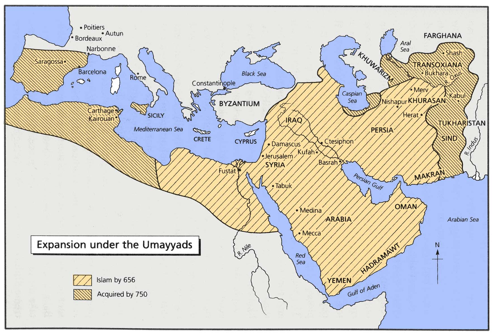
Within 100
years after Muhammad’s death the Islamic Empire went from Spain to Pakistan.
This map is
from p. 50 of Armstrong’s Islam
Below is the
Roman Empire for comparison.

In Damascus (modern day Syria) Muslims and Christians even
shared church buildings for worshiping.
Baghdad was the center of Islamic philosophy starting in the 8th century. Baghdad (Iraq) was
centrally located in relation to the Islamic world of the day. Scholars from
all over the western world studied in Baghdad. The Greek and Roman authors were
studied in great detail, translated into Arabic, and elaborated upon and
developed. In the 8th, 9th, 10th, and 11th centuries, Arabic was the
language of the intelligentsia much like English is today or Latin was in the
late Middle Ages and the Renaissance in Western Europe.
A few of the more famous Islamic philosophers:
Avicenna (980-1037) from Persia, wrote
extensively on the classical authors such as Plato and Aristotle he also wrote
the most influential book on medicine, perhaps ever, called The Cannon.
Alhazen (965-1040) wrote a very
influential book on optical theory and mathematics which was influential into
the 15th century.
Averroës (126-1198) from Spain, was a
hugely influential philosopher and mathematician.
Trivia:
Islamic doctors could perform surgery to remove cataracts,
and gall stones.
The Muslim world promoted a huge book industry, written by
scribes, some of whom were women.
The “check” was developed by Islamic merchants; write it in
Spain and cash it in Baghdad.
Damascus and Spanish (Toledo) Steel was the finest
edge-holding and durable metal in the Western world. Swords made by these Muslim craftsmen were considered to be
the best obtainable.

Damascus
Steel
Cordoba, Spain in the 9th and 10th centuries
was similar to Baghdad in its majesty. There were street lights, running water,
libraries, and gigantic structures.
Fabrics were also of the highest quality and were later
coveted by European’s with money.
When the Crusaders encountered the Islamic civilization in
the late 11th century
they were amazed at their level of sophistication and technical know-how. The
world of Islam made medieval Europe look dingy and primitive by comparison.