|
HoST Fall 2010 Tues/Thurs. starting at 4:00 in Babio 203 |
Back to HoST Fall 2010 Syllabus Email me: host@mifami.org |
Week of 11/9 and 11/11
Assignment 10
A Scientific Revolution: Part I
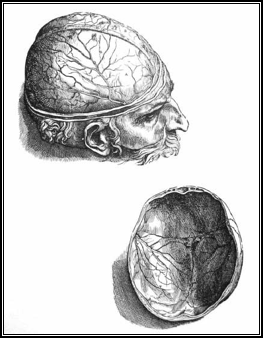
Vesalius-from De Humani Corporis Fabrica-1543
Tuesday:
Look at this scale graphic of our
solar system. Scroll through the
whole thing. You’ll notice why Uranus, Neptune, and Pluto were not seen by the
pre-moderns.
Here is
another site with the same idea:
Read the chapter titled “Copernicus
Incited a Revolution” in McClellan and Dorn. (It is Chapter 11 in newer editions and chapter 10 in older
editions.) Look over this web page
and as you read the McClellan and Dorn, follow along with the materials I have
posted below.
Read this web page entirely and play
with the links provided.
Browse over these parts of Kepler’s Mysterium
cosmographicum (1596) – Kepler_MystCosmoExcerptsSm-OCRd-imaged-5.9MB.pdf.
Don’t skip the title page and all the fluff. The fluff is as interesting as the meat of the book. Just
poke around this PDF and see if anything grabs your attention.
Browse through these excerpts from
Vesalius’ De
humani corporis fabrica [On the fabric of the human
body] from 1543. Just look over the illustrations and study a few of them
closely.
Vesalius_DeFabrica100-OCR-9.8MB.pdf
View this movie: Copernican
explanation of the retrograde motion of Mars: http://www.astro.uiuc.edu/projects/data/Retrograde/
Thursday:
Read this selection of things on and by
Girolamo Cardano:
Cardano-Book_of_My_Life-excerpts-100dpi-9.2MB.pdf
…or here is a somewhat smaller, lower
resolution version…
Cardano-Book_of_My_Life-excerpts-100dpiLow-6.9MB.pdf
-pp. ix-xviii (The
“Introduction” by Grafton), just skim this over...
-pp. 5-7 (“My Nativity)
-pp. 20-24 (“Concerning
My Health”)
-pp. 91-104 (“Perils,
Accidents, and …Treacheries”)
-this reading is also
listed as a resource for a long essay... just read about 20 pages more than the
assignment.
Homework: On Tuesday
I will have passed back your project homework from last week. Don't lose these sheets! I want next week's homework done on the
back of them... or stapled to them.
Citations to the
assigned readings.
Kepler, Johannes, and E. J.
Aiton. The
Secret of the Universe (Mysterium Cosmographicum). Translated by A.M.
Duncan and with introduction and commentary by E.J. Aiton and a preface by I.
Bernard Cohen. New York: Abaris Books, 1981.
McClellan, James E., and Harold
Dorn. Science
and Technology in World History : An Introduction. Baltimore, Md.: The
Johns Hopkins University Press, 1999.
Vesalius, Andreas,
J. B. de C. M. Saunders, and Charles Donald O'Malley. The illustrations from the works of Andreas Vesalius
of Brussels; with annotations and translations, a discussion of the plates and
their background, authorship and influence, and a biographical sketch of
Vesalius. New York,: Dover Publications, 1973.
Cardano,
Girolamo, and Anthony Grafton. The Book of My Life (De Vita Propria Liber). Translated by
Tranlated from the Latin by Jean Stoner. New York: New York Review Books, 2002,
written in the 1570s.
The
following are selections from various astronomical texts from this period,
usually referred to as the beginning of the Scientific Revolution.
You
should look at these as you read the McClellan and Dorn.
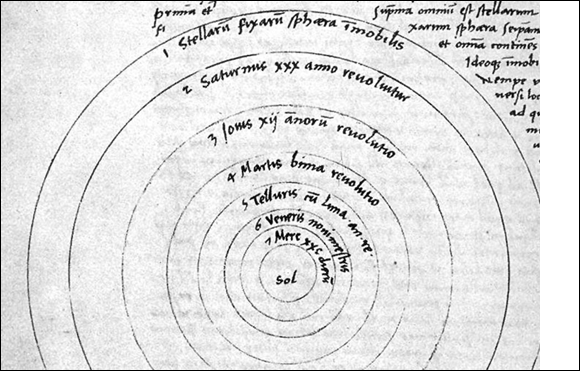
This is a
reproduction from the manuscript by Copernicus.
[available
here: http://www.bj.uj.edu.pl/bjmanus/revol/titlpg_e.html]
In comparing
this with the printed version [below] I notice that the labels are below the
circular lines rather than sitting above them as in the printed edition. Also the sun is just a word and the
moon is not shown at all. Is this
significant? I really don’t know,
but this manuscript drawing seems to more clearly imply a finite and contained
universe, with the sphere of the fixed stars clearly enclosing the universe,
whereas the printed version suggests something outside this sphere. This is more of an issue with
Aristotle, but later theological debates over the size of the universe and the
possibility of other worlds might have been exacerbated by the somewhat
ambiguous diagram in the printed version.

Here
is a page from the first printed edition of 1542/3.
The Latin text above and below
this diagram reads as follows. The
exact section shown in the page image above is in blue.
The sphere of the fixed stars is
followed by the first of the planets, Saturn, which completes its circuit in 30
years. After Saturn, Jupiter accomplishes its revolution in 12 years. Then Mars
revolves in 2 years. The annual revolution takes the series’ fourth place, which contains the earth, as I said [earlier in I, 10],
together with the lunar sphere as an epicycle. In the fifth place Venus returns
in 9 months. Lastly, the sixth place is held by Mercury, which revolves in a
period of 80 days.
[You
will note that the numbers on this diagram do not correspond with the text that
surrounds this illustration. I have two theories for this. 1) This can be
explained by the difference between cardinal and ordinal numbers. In your first year of life you are not
yet one year old. When you are finally one year old you are in your second year
of life. The diagram uses cardinal
numbers while the description uses ordinal. 2) In the text Saturn is the first planetary sphere
as distinguished from the sphere of fixed stars. Either way, his presentation is a bit confusing.]
At rest, however, in the middle of everything is the sun. For in
this most beautiful temple, who would place this lamp in another or better
position than that from which it can light up the whole thing at the same time?
For, the sun is not inappropriately called by some people the lantern of the
universe, its mind by others, and its ruler by still others. [Hermes] the
Thrice Greatest labels it a visible god, and Sophocles’ Electra, the
all-seeing. Thus indeed, as though seated on a royal throne, the sun governs
the family of planets revolving around it. Moreover, the earth is not deprived
of the moon’s attendance. On the contrary, as Aristotle says in a work on
animals [De anima? On the Soul?], the moon has the closest kinship with the
earth. Meanwhile the earth has intercourse with the sun, and is impregnated for its
yearly parturition.
[The earth has
“intercourse with the sun and is impregnated.” That’s an interesting description.]
In this arrangement, therefore,
we discover a marvelous symmetry of the universe, and an established harmonious
linkage between the motion of the spheres
and their size, such as can be found in no other way. For this permits a
not inattentive student to perceive why the forward and backward arcs appear
greater in Jupiter than in Saturn and smaller than in Mars, and on the other
hand greater in Venus than in Mercury. This reversal in direction appears more
frequently in Saturn than in Jupiter, and also more rarely in Mars and Venus
than in Mercury. Moreover, when Saturn, Jupiter, and Mars rise at sunset, they
are nearer to the earth than when they set in the evening or appear at a later
hour. But Mars in particular, when it shines all night, seems to equal Jupiter
in size, being distinguished only by its reddish color. Yet in the other
configurations it is found barely among the stars of the second magnitude,
being recognized by those who track it with assiduous observations. All these
phenomena proceed from the same cause, which is in the earth’s motion.
Copernicus,
Nicholas. De
Revolutionibus Orbium Coelestium; Translated by Edward Rosen. New York:
Dartmouth College, Sept. 1999 accessed 2004; Available from http://math.dartmouth.edu/~matc/Readers/renaissance.astro/1.1.Revol.html.

Sun
Centered Copernican System, first proposed in public in 1540.
Sun-Mercury-Venus-Earth
(with moon)-Mars-Jupiter-Saturn-Starry Sphere
This
image and the detail from it is from 1543, Book I, Chapter X of
On
the Revolutions of the Heavenly Spheres.
Here
are the translations of the spherical captions.
I.
Immobile sphere of the fixed stars
II.
Saturn, is turned in 30 years
III.
Twelve-year revolution of Jupiter
IV.
Two-year revolution of Mars
V.
Earth (Tellus), with the orb of the moon …[?] …
VI.
Venus nine month return
VII.
Mercury … [?] …80 days
VIII.
The Sun

Martin Luther’s Comment on Copernicus

Cosmological
System of Tycho Brahe, ca. 1577
It is earth
centered, but all other bodies besides moon orbit the sun, which orbits the
earth.
Given
the date, why is Tycho’s theory somewhat odd?
Here is
a FlashMovie of his system: Tycho for
Windows or Tycho for Mac
The
Systems if Johannes Kepler (1571-1630)

Detail
from Kepler’s first cosmological system from Mysterium cosmographicum – detail
of the cosmos. (1596)
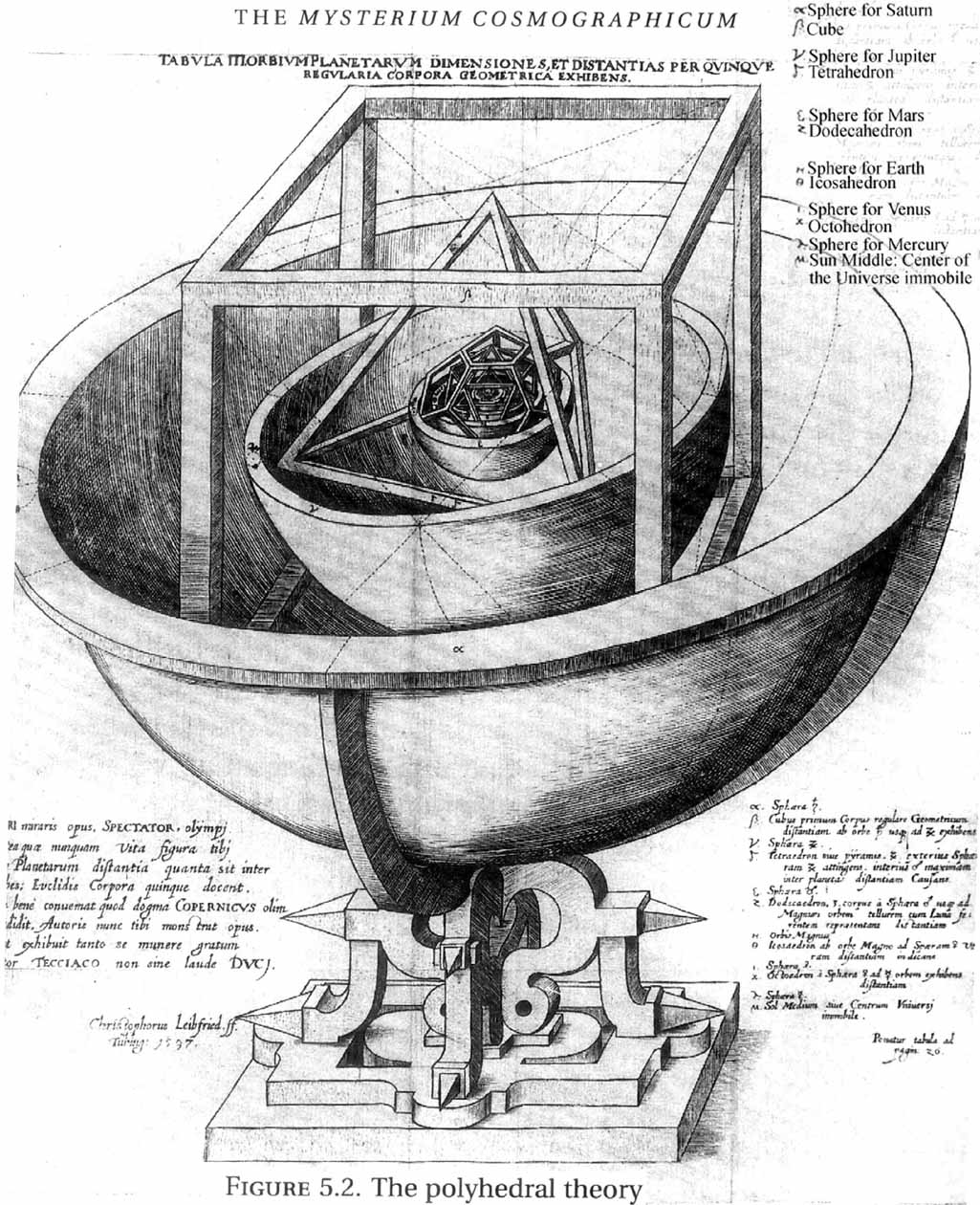
Full Image Link (with translated details- click on thumbnail)


Click on this link to hear the cosmos sing.
This link plays the music of the
planets as Kepler’s mind’s ear heard them. This piece produced by Produced by Willie Ruff and John
Rodgers
starts
with Mercury and keeps adding in planets (Venus, Earth, Mars…etc). You can follow along by referring to
the score below, which presents the planets in the opposite order.


Notice the
eccentricities. The bigger the eccentricity the greater the interval the planet
sweeps out in its song.
Compare with the
music directly above this chart. When viewed in this way, Kepler’s use of music
is not quite so strange.
Tons of astronomical animations can be found here: http://www.csit.fsu.edu/~dduke/models.htm
Last week I mentioned where Hg
(Mercury) came from. Here is the
Roman architect, Vitruvius, on this issue. Vitruvius-excerpt-cinnabar-mercury-544KB.pdf
It’s just a page or so long. It is
quite interesting because it covers mining, extraction, chemical and alchemical
techniques, matter theory, and uses.
Need a point of two? Write a modern theoretical counterpoint to Vitruvius’ description
and some other thoughts that come to you.
Vitruvius, Dewar, Howe, and
Rowland. Ten
Books on Architecture (De Architectura Libri Decem). Translation from the
Latin and commentary by Ingrid D. Rowland. Additional commentary by Michael J.
Dewar. Illustrations and commentary by Thomas Noble Howe. Cambridge: Cambridge
University Press, 1999 (from first century BC).
Short and Long Essays.
We now have a lot of background
to work with. Short and Long
Essays still need to refer in some manner to the readings for this week, but
now you should be able to also refer to previous readings and maybe even launch
out on your own a bit. Be
creative. Don't forget that image
analysis is always an option.
Fictional dialogues between different characters... comic books... even
sci-fi plots or historical fictions that incorporate some of the theories and
technologies we read about. Cite
sources.
Long Essay writers may choose to
go with a witchcraft topic (or not).
Tying witches into the McClellan and Dorn reading might be a bit tricky,
so feel free to just make a passing reference to the historical period
described in the McClellan and Dorn reading and then write about witches. I'll be particularly impressed if you can
work into your essay some older readings.
Long Essay resources:
Struik,
Dirk Jan. A
Source Book in Mathematics, 1200-1800 Source Books in the History of the
Sciences. Cambridge, Mass.,: Harvard University Press, 1969. [The section
on algebra and Cardano’s (also spelled Cardan) input to this type of
math. See also the Osler article for additional commentary on this sort
of stuff.] Struik_SourceBook-Algebra-Cardano.pdf
Walker, Jonathan. "Gambling and Venetian Noblemen C.1500-1700." Past and Present, no. 162 (1999): 28-69. Looks good… Walker_GamblingVenice-4.1MB.pdf
Christianson,
Gale E. "Kepler's Somnium: Science Fiction and the Renaissance
Scientist." Science
Fiction Studies 8, no. 1 (1976). http://www.depauw.edu/sfs/backissues/8/christianson8art.htm
Nicolson, Marjorie.
"Kepler, the Somnium, and John Donne." Journal of the History of Ideas 1, no. 3
(1940): 259-280. Nicolson_KeplerSomniumDonne-660KB.pdf
Osler, Thomas J. "Cardan Polynomials and the Reduction of Radicals." Mathematics Magazine 74, no. 1 (2001): 26-32. Osler_CardanPolynomialsReduction-484KB.pdf
Cardano, Girolamo, and Anthony Grafton. The Book of My Life (De Vita Propria Liber). Translated by Tranlated from the Latin by Jean Stoner. New York: New York Review Books, 2002, written in the 1570s. Cardano-Book_of_My_Life-excerpts-100dpi-9.2MB.pdf [this is the same link as the reading for Thursday.]
Gouk, Penelope. "The Role of Harmonics in the Scientific Revolution." In The Cambridge History of Western Music Theory, ed. Thomas Street Christensen, pp. 223-245. Cambridge ; New York: Cambridge University Press, 2001. Gouk_HarmonicsInSciRev-2.6MB.pdf
Kepler, Johannes, and E. J. Aiton. The Secret of the Universe (Mysterium cosmographicum). Translated by A.M. Duncan and with introduction and commentary by E.J. Aiton and a preface by I. Bernard Cohen. New York: Abaris Books, 1981. Kepler_MystCosmoExcerptsSm-OCRd-imaged-5.9MB.pdf. [This is the same link as the one for "looking over" on Tuesday. Read/analyze some part of this for a long essay.]
Stephens, Walter. Demon Lovers : Witchcraft, Sex, and the Crisis of Belief. Chicago: University of Chicago Press, 2002. Super interesting and rather sordid. The chapter on the Maleus Maleficarum is a very good overview and would be a good place to start an investigation on this book (starts on p32, which is PDF-page 40). See also a section that tells a story of witches who steal male members (starts on p300, which is PDF-page 29). Stephens_Demon_LoversExcerpts100-4.8MB.pdf [If you read the male organ stealing section, also read this Reuters-Congo-PenisStealingWitchesLynched-2008 and this, link]
Connor, James A. Kepler's Witch: An Astronomer's Discovery of Cosmic Order Amid Religious War, Political Intrigue, and the Heresy Trial of His Mother. 1st ed. San Francisco: HarperSanFrancisco, 2004. Connor_KeplersWitchCh1-2.7MB.pdf Pp. 13-end-of-PDF is the part that sets up Kepler's mother's crime.
Bragg, Melvyn. "Witchcraft." In In Our Time, 45 minutes. London: BBC, 2004. IOT_ Witchcraft.mp3
-Melvyn Bragg and guests discuss witchcraft in Reformation Europe. In 1486 a book was published in Latin, it was called Maleus Mallificarum and it very soon outsold every publication in Europe bar the Bible. It was written by Heinrich Kramer, a Dominican Priest and a witchfinder. "Magicians, who are commonly called witches" he wrote, "are thus termed on account of the magnitude of their evil deeds. These are they who by the permission of God disturb the elements, who drive to distraction the minds of men, such as have lost their trust in God, and by the terrible power of their evil spells, without any actual draught or poison, kill human beings."
"Thou shalt not suffer a witch to live" says Exodus, and in the period of the Reformation and after, over a hundred thousand men and women in Europe met their deaths after being convicted of witchcraft.
Why did practices that had been tolerated for centuries suddenly become such a threat? What brought the prosecutions of witchcraft to an end, and was there anything ever in Europe that could be truly termed as a witch?
With Alison Rowlands, Senior Lecturer in European History at the University of Essex; Lyndal Roper, Fellow and Tutor in History at Balliol College, University of Oxford; Malcolm Gaskill, Fellow and Director of Studies in History at Churchill College, Cambridge. http://www.bbc.co.uk/programmes/p004y2b0
Kramer, and Sprenger. Malleus Malifacarum. written 1476, published 1487. This needs some more citation information. Kramer-Sprenger-Malleus_maleficarum.pdf [This PDF is not all that easy to navigate.] This is the classic witch-hunting manual. Find 20 or so pages of interest and read them. This is also available online in html format here: malleusmaleficarum.org, however this site is a bit wonky. Go to the "Contents" located in the center column and go to the 1st, 2nd, or 3rd part index and from there choose an interesting "question." The questions in the 2nd and 3rd parts appear to be the most interesting for an introduction to witch hunting. Those who use this as a source might also find the "WitchCondemnation1472Florence" PDF interesting as well.
Ross, Eric B. "Syphilis, Misogyny, and Witchcraft in 16th-Century Europe." Current Anthropology 36, no. 2 (1995): 333-337. Ross_Syphilis,Misogyny,Witchcraft16thc-1.1MB.pdf. If you use this you also must use the citation "WitchCondemnation1472Florence."
WitchCondemnation1472Florence-332KB.pdf- Make up a citation for this if you use it. WitchCondemnation1472Florence-332KB.pdf
Optional....

Centers for Disease
Control and Prevention, via Getty Images
A
bubonic plague smear, prepared from a lymph removed from an adenopathic lymph
node,
or
bubo, of a plague patient, demonstrates the presence of the Yersinia pestis
bacteria that causes the plague.
Wade- Europe’s
Plagues Came From China, Study Finds-10/31/10-NYTimes
Back to HoST Fall 2010 Syllabus
Email me: host@mifami.org

Image by Francesco Parmigianino -ca.1530